
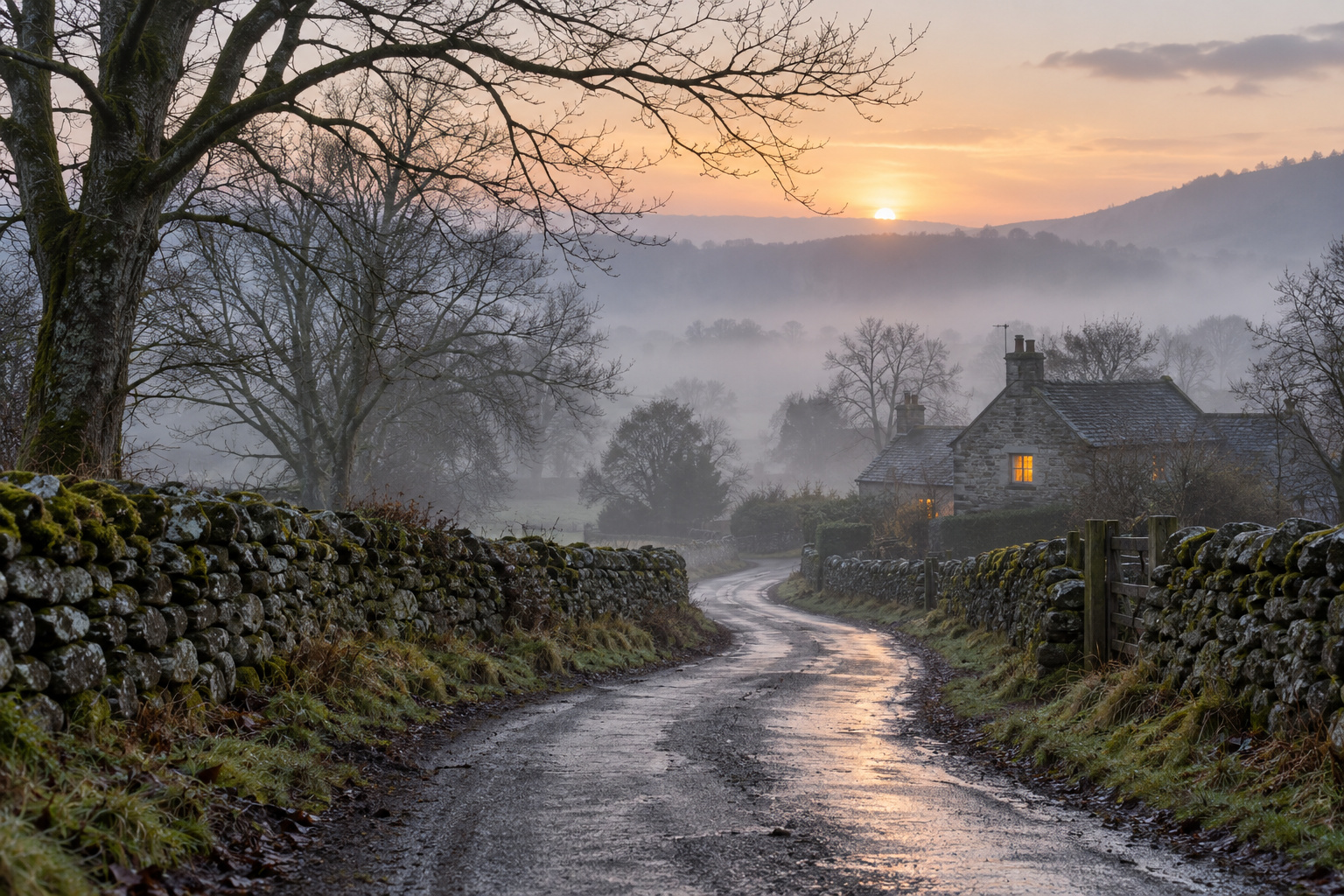
The setting of a story is where and when it takes place: the physical location, the time period, the season and time of day, and the social world the characters live in, including its customs, class rules and mood. A good setting is more than a backdrop. It shapes what characters can do, adds pressure to the plot and sets the emotional tone readers feel on every page.
This guide includes a few product links near the end. As an Amazon Associate, Freyja Publishing earns from qualifying purchases, at no extra cost to you.
This guide explains the elements of setting, the difference between a setting that simply sits behind the action and one that drives it, how to filter description through your point-of-view character, what readers expect from setting in different genres, and a sensory-detail checklist you can use while drafting or revising.
At a glance
- Setting has five working parts: place, time, social world, weather and season, and atmosphere.
- A backdrop setting could be swapped for another without changing much; an integral setting shapes the plot and characters.
- Describe setting through your point-of-view character’s eyes, mood and priorities, not like a camera.
- Genre sets expectations: cosy mysteries need a contained community, fantasy needs consistent rules, small-town romance needs a place that feels like a character.
- Two or three precise, unexpected details beat a paragraph of general description.
What is a setting to a story?
Reference works such as the EBSCO Research Starters entry on setting describe it as the element that establishes where and when a story happens, from a broad historical era down to a single room, and note that it underpins mood, tone and theme. That is the textbook meaning. For a novelist, the more useful question is: what does this place and time do to my characters?
Consider Charlotte Perkins Gilman’s short story “The Yellow Wallpaper”. Almost all of it happens in one upstairs room, yet the room and its wallpaper become the centre of the story as the narrator’s state of mind changes. A setting does not need to be large to matter. It needs to press on the people in it.
The elements of setting
| Element | What it covers | Questions to ask |
|---|---|---|
| Place | Country, town, building, room, landscape | What can and can’t happen here? Who has power in this space? |
| Time | Era, year, season, day of the week, hour | What technology, laws and attitudes exist? What deadlines does the calendar create? |
| Social world | Class, culture, religion, politics, community rules, work | What would get a character judged, shunned or punished here? |
| Weather and environment | Climate, light, temperature, natural hazards | Can the weather trap, slow or expose anyone? |
| Atmosphere | The mood the place creates | How should the reader feel when they enter this scene? |
Most writers think hard about place and forget the social world. Yet in Jane Austen’s novels, the physical places are described lightly while the social rules (inheritance, rank, reputation) do enormous work. The setting is the society.
Setting as a literary device: backdrop vs integral
A helpful test: could you move your story to a different city or century without changing the plot? If yes, your setting is a backdrop. If no, it is integral.
| Backdrop setting | Integral setting | |
|---|---|---|
| Role | Provides a believable stage | Creates obstacles, opportunities and meaning |
| Example | A generic office in a workplace comedy | The moors in Emily Brontë’s Wuthering Heights, isolated and wild like the passions they surround |
| Amount of description | Light; enough to orient the reader | Recurring, layered, changing as the story changes |
| Risk | Can feel bland or interchangeable | Can overwhelm the characters if over-described |
| Best for | Dialogue-led or very fast-paced stories | Romance, fantasy, historical, gothic, cosy mystery |
Neither is wrong. But in most commercial genres, at least one or two locations should be integral. L. Frank Baum’s The Wonderful Wizard of Oz shows the contrast neatly: the grey Kansas farm and the vivid Land of Oz are not interchangeable, and each place reflects what Dorothy is missing or learning.
How to describe a setting in a story: filter it through point of view
Literary agent and craft writer Donald Maass, in Writing the Breakout Novel, encourages writers to go beyond describing a place and to show how it makes the point-of-view character feel. In our own words: the setting on the page should be the character’s experience of the setting, not a neutral inventory.
Compare two versions of the same kitchen (both invented for this guide):
- Camera view: “The kitchen had a wooden table, a blue kettle and a window overlooking the garden.”
- Filtered through a grieving daughter: “Mum’s blue kettle still sat on the back burner, handle turned out the way she liked it, as though she’d be back in a minute to fill it.”
The second gives the reader less furniture and far more story. What a character notices depends on who they are: a builder sees the cracked lintel, a chef sees the cheap knives, a frightened teenager sees the only exit. The point of view guide covers how close or distant your narration should be, which affects how much the setting is coloured by the character’s feelings.
Practical rules for setting description
- Orient fast. In the first few lines of a new scene, let readers know roughly where and when they are.
- Choose two or three specific details rather than ten general ones. Specific beats complete.
- Use more than sight. Sound, smell, temperature and texture make a place physical.
- Link the detail to emotion or plot. Every detail should either reveal the character, set the mood or set up something that matters later.
- Weave, don’t dump. Slip description into action and dialogue instead of stopping the story for a paragraph of scenery.
- Let the setting change. The same place should feel different after something has happened there.
Openings are where description most often runs too long. The guide on how to start a story covers how much setting your first page really needs.
Setting expectations by genre
Readers of different genres come for different things. Meeting those expectations is part of what the genre mastery guide calls writing to the market.
| Genre | What readers expect from setting | Watch out for |
|---|---|---|
| Small-town romance | A community with recurring faces, local businesses and traditions; a place the couple might build a life in | A town so perfect nothing can go wrong |
| Big-city or holiday romance (for example, Christmas in New York) | Iconic seasonal atmosphere balanced with a private, specific corner of the city that belongs to the couple | A tour-guide list of landmarks with no personal meaning |
| Cosy mystery | A closed, charming community (village, bookshop, bakery) where the suspects all know each other | Grim violence that breaks the cosy tone |
| Thriller | Settings that trap, expose or isolate; clear geography readers can follow in action scenes | Confusing layouts during chases |
| Fantasy | A world with consistent rules (magic, politics, economy) revealed through story | Long info-dumps of history and maps |
| Historical | Accurate period detail in daily life, speech and social rules | Modern attitudes and objects slipping in |
| Gothic and horror | Isolation, decay, darkness, a house or landscape with secrets | Atmosphere with no escalating threat |
Romance writers often use place as a hook for a whole series: one town, many couples. If you are planning that, the guide to planning a book series covers keeping a shared setting consistent across books. Setting also pairs naturally with tropes: a snowed-in cabin, a small-town festival, a fake-dating holiday party. The love tropes guide lists many that depend on place.
Worldbuilding without the info-dump
Fantasy and science fiction need more setting than most genres, but the principle is the same: reveal the world when it matters to the character. A few techniques:
- Show rules through consequences. Instead of explaining that magic costs memory, show a mage forgetting her sister’s name.
- Use an outsider sparingly. A newcomer character lets others explain things, but too much of it feels like a lecture.
- Keep a private “world bible”. Write the history, money, laws and geography for yourself, then use only what scenes need.
- Name things once, clearly. Too many invented terms in one chapter tires readers.
- Let daily life carry the world. What people eat, how they pay, what they swear by and what they fear tells readers more than a page of history.
Sensory-detail checklist for any scene
Use it at planning stage for key locations, then again in revision for any scene a beta reader found hard to picture. Run through this list once per new location. You won’t use every line, but it stops settings feeling flat.
- Where exactly are we, and how does the reader know within three lines?
- What time of day and season is it? Does light or weather show it?
- What is one sound the POV character notices?
- What is one smell or taste?
- What does the character touch, and what does it feel like?
- What is one detail only this character would notice?
- What is the mood of the place, and does it match or contrast with the character’s mood?
- What social rule applies here (who belongs, who doesn’t)?
- Can the setting help or hinder the goal of this scene?
- If we return here later, what will have changed?
Common mistakes
- The opening weather report. A long paragraph of landscape before anything happens.
- White-room scenes. Characters talk in a void with no sense of space, time or objects.
- Camera-eye description. Neutral lists of furniture that reveal nothing about the character.
- Postcard settings. Famous landmarks with no personal or story meaning.
- Inconsistent geography. Rooms, distances or travel times that change between chapters. Track them as you revise; the self-editing guide includes continuity passes.
- Ignoring the social setting. Getting the buildings right but the manners, money and power wrong.
- A setting that never changes. The place should reflect what has happened in it.
Sources this guide draws on: EBSCO Research Starters entry on setting in literature; Donald Maass, Writing the Breakout Novel (setting and the point-of-view character’s emotions), summarised in our own words; Charlotte Perkins Gilman, “The Yellow Wallpaper”; L. Frank Baum, The Wonderful Wizard of Oz; Emily Brontë, Wuthering Heights; Jane Austen’s novels.
Writer’s toolkit for this guide
Books and tools we rate for this stage of writing and publishing. As an Amazon Associate, Freyja Publishing earns from qualifying purchases, at no extra cost to you. Prices and availability are set by Amazon and may vary by country.
- On Writing: A Memoir of the Craft by Stephen King
Part memoir, part masterclass on the daily habit of writing.
View on Amazon - Save the Cat! Writes a Novel by Jessica Brody
A beat-by-beat plotting method adapted for novelists.
View on Amazon - LEUCHTTURM1917 A5 Hardcover Notebook
Numbered pages and an index, handy for plot notes and research.
View on Amazon
Frequently asked questions
What is the setting of a story in simple words?
It is where and when the story happens. That includes the place, the time period, the time of day or year, and the society and mood surrounding the characters.
Why is setting important in a story?
Setting creates mood, makes the story believable and limits what characters can do. A strong setting adds obstacles and opportunities to the plot and can reflect the theme and the characters’ feelings.
What are the main elements of setting?
The usual elements are place, time, social environment, weather or natural environment, and atmosphere. Writers often neglect the social environment, which covers class, customs and rules about who belongs.
How much setting description is too much?
If readers skim it, it is too much. Aim for a few specific details woven into action, and longer description only when the place matters to the plot or the character’s emotional state at that moment.
Can a setting be a character?
People say a setting is “like a character” when it has a strong personality, changes over the story and affects the plot, as the moors do in Wuthering Heights. It is a figure of speech, but a useful goal for romance, gothic and fantasy writers.
Does a short story need a detailed setting?
It needs a clear one, not a long one. Short stories usually use a single key location and a handful of sharp details. The guide to writing a short story covers keeping every element tight.
Setting is the ground your story stands on. Choose places that press on your characters, describe them through the eyes of someone who cares, and readers will feel they have been there.