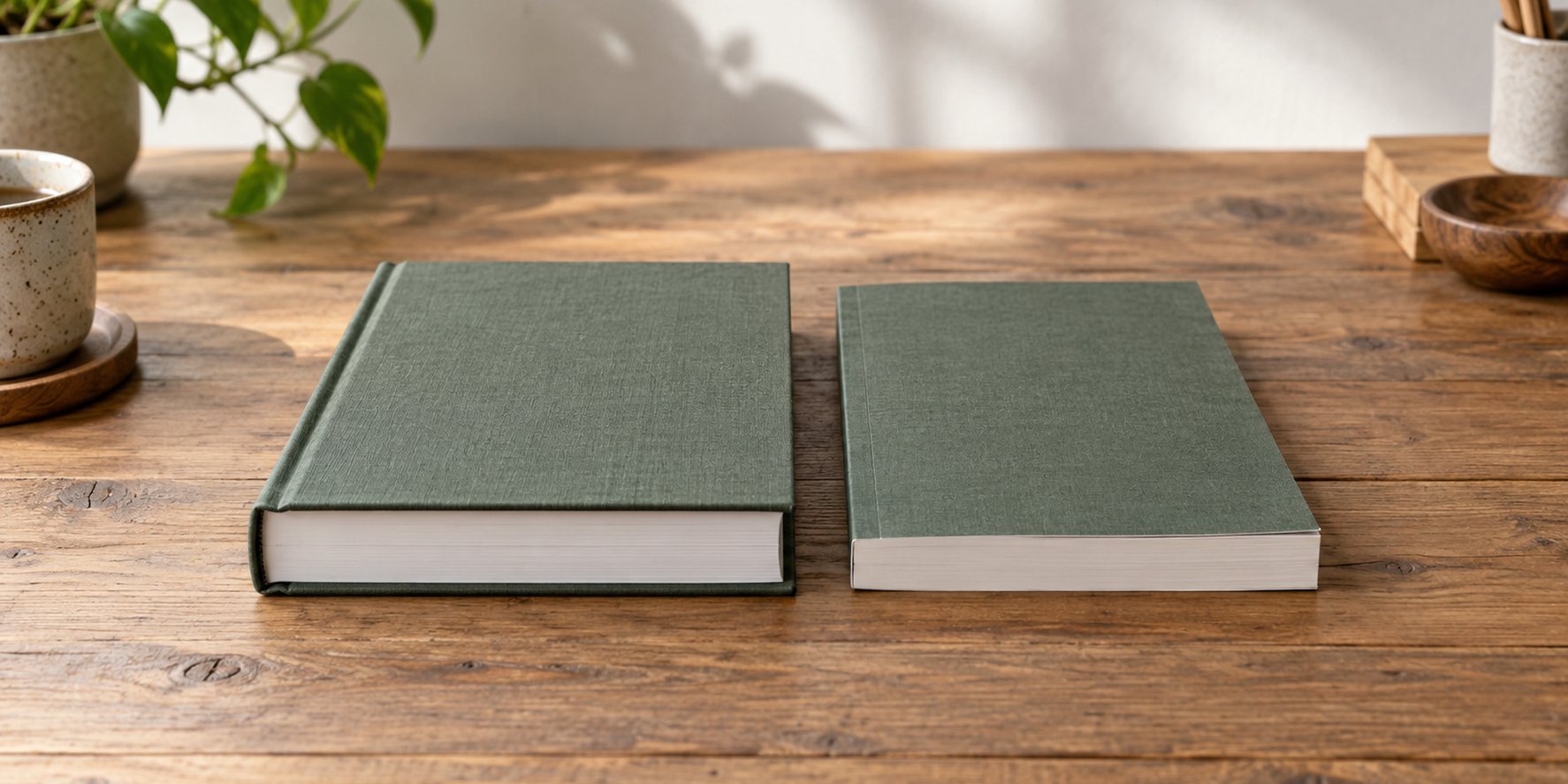
For most self-published authors, the paperback is the format to offer first and the hardcover is the optional extra. On Amazon KDP, a hardcover costs several dollars more to print than a paperback of the same length, so it has to be priced much higher just to earn a similar royalty per copy. A hardbound edition is usually worth adding when your readers actually want one: gift books, children’s books, special editions for fans and books aimed at libraries.
This guide includes a few product links near the end. As an Amazon Associate, Freyja Publishing earns from qualifying purchases, at no extra cost to you.
This guide compares hardcover vs paperback from the author’s side: printing costs on KDP, worked royalty examples at common page counts, minimum list prices, what IngramSpark adds, and a checklist for deciding whether to offer both. All figures are for the Amazon.com marketplace in US dollars at the time of writing (October 2026). Prices change, so check the current KDP and IngramSpark pages before you set yours.
At a glance
- Hardcovers cost far more to print. On KDP, a 300-page black-ink book at a standard trim costs US$4.60 to print as a paperback and US$9.25 as a hardcover.
- The royalty gap is smaller than the price gap. A hardcover priced US$10 above the paperback may earn only a little more per copy.
- KDP hardcovers start at 75 pages and do not have Expanded Distribution, so they sell through Amazon only.
- IngramSpark offers more hardcover options, including jacketed and cloth-look editions and shorter page counts, and reaches bookshops and libraries.
- Offer both when your genre or audience gives a reason to. Gifting, children’s books, collectors and libraries are the usual reasons.
Hardcover vs paperback: the formats explained
A paperback (or softcover) has a flexible card cover glued to the page block, which printers call perfect binding. A hardcover (or hardback, hardbound or case-bound book) has rigid boards. Print-on-demand hardcovers are most often case laminate, where the cover art is printed directly onto paper wrapped around the boards. Some printers also offer a dust jacket or a cloth-style finish.
Whether you call it hardbound vs paperback or hardback vs paperback, the choice is the same. For readers, the difference is durability, weight and price. For authors, the difference is mainly cost: the boards and binding add a substantial fixed amount to every copy.
KDP printing costs: paperback vs hardcover
KDP calculates printing cost as a fixed cost plus a per-page cost. The figures below are from KDP’s Paperback Printing Cost and Hardcover Printing Cost help pages for Amazon.com, at the time of writing (October 2026). “Regular” trim means up to 6.12 inches wide and 9 inches high; anything larger is a “large” trim with higher costs.
| Format and ink | Page range | Regular trim | Large trim |
|---|---|---|---|
| Paperback, black ink | 24 to 110 | US$2.30 flat | US$2.84 flat |
| Paperback, black ink | 110 to 828 | US$1.00 + US$0.012 per page | US$1.00 + US$0.017 per page |
| Paperback, premium colour | 42 to 828 | US$1.00 + US$0.065 per page | US$1.00 + US$0.08 per page |
| Hardcover, black ink | 75 to 108 | US$6.80 flat | US$7.49 flat |
| Hardcover, black ink | 110 to 550 | US$5.65 + US$0.012 per page | US$5.65 + US$0.017 per page |
| Hardcover, premium colour | 75 to 550 | US$5.65 + US$0.065 per page | US$5.65 + US$0.08 per page |
The per-page costs are the same for both formats; the difference is the fixed cost. For a black-ink book over 110 pages, a hardcover costs US$4.65 more to print than a paperback of the same length and trim, whatever the page count. KDP also lists standard colour and groundwood paper for paperbacks, but not for hardcovers.
Trim sizes and page limits
KDP hardcovers come in five trim sizes at the time of writing: 5.5 x 8.5, 6 x 9, 6.14 x 9.21, 7 x 10 and 8.25 x 11 inches, each from 75 to 550 pages, in black ink on white or cream paper or premium colour on white. Paperbacks have many more trim sizes and can run from 24 pages up to 828 pages for most sizes, depending on ink and paper. That 75-page hardcover minimum matters for picture books, many of which are 32 pages: those cannot be KDP hardcovers.
How royalties work for each format on KDP
KDP’s print royalty formula is the same for both formats: royalty = (list price x royalty rate) minus printing cost. On Amazon.com, KDP’s paperback royalty page states a 60% rate for list prices of US$9.99 and above and 50% at US$9.98 and below; KDP’s print pricing page shows the same 50% or 60% structure for print books. The minimum list price is the printing cost divided by the royalty rate. Because hardcover printing costs are high, hardcover minimums land well above US$9.99, so the 60% rate is the one that normally applies. Check KDP’s Hardcover Royalty page for your marketplace before you publish.
One more difference: KDP states that Expanded Distribution is not available for hardcover books. Paperbacks can use it (at a 40% rate minus printing) to reach other retailers; KDP hardcovers sell on Amazon only. The guide to print-on-demand maths goes deeper on paperback margins and Expanded Distribution.
Worked examples: what each format earns per copy
All examples use a 6 x 9 inch black-ink book on Amazon.com at the time of writing (October 2026). They are arithmetic from KDP’s published formulas, not predictions of sales or income.
| Page count | Paperback print cost | Hardcover print cost | Hardcover minimum list price (60%) |
|---|---|---|---|
| 200 pages | US$3.40 | US$8.05 | About US$13.42 |
| 300 pages | US$4.60 | US$9.25 | About US$15.42 |
| 400 pages | US$5.80 | US$10.45 | About US$17.42 |
Now a 300-page novel at typical-looking prices:
- Paperback at US$14.99: 60% of US$14.99 is US$8.99, minus US$4.60 printing, leaves about US$4.39 per copy.
- Hardcover at US$19.99: 60% is US$11.99, minus US$9.25, leaves about US$2.74, less than the cheaper paperback.
- Hardcover at US$24.99: 60% is US$14.99, minus US$9.25, leaves about US$5.74, only about US$1.35 more than the paperback while the reader pays US$10 more.
The lesson: a hardcover does not automatically earn more. To match or beat the paperback’s royalty, it has to be priced significantly higher, and readers only pay that if the hardcover offers them something they value.
A larger colour book
For an 80-page, 8.25 x 11 inch premium-colour book (a large trim), KDP printing works out to US$7.40 as a paperback (US$1.00 + 80 x US$0.08) and US$12.05 as a hardcover (US$5.65 + 80 x US$0.08). The hardcover’s minimum list price at 60% is therefore about US$20.08 before it earns a cent. Colour books are where hardcover pricing needs the most care; the guide to self-publishing a children’s book covers the wider choices.
What IngramSpark adds
IngramSpark is the other print-on-demand option most indie authors consider for hardcovers. According to its help centre at the time of writing (October 2026), it offers:
- Case laminate hardcovers, with the cover printed directly onto the case, in gloss or matte.
- Digital Cloth covers, a cloth-look case in blue or grey with gold spine text.
- Jacketed hardcovers, where available by trim size, including a matching dust jacket option.
- Shorter and longer books: hardcovers from 18 pages, with maximum page counts that depend on the paper.
IngramSpark also distributes through Ingram’s network to bookshops and libraries, which is often the main reason authors set up a hardcover there. Its earnings work differently from KDP: you set a list price and a wholesale discount, and your compensation is what remains after the discount and printing cost. Use IngramSpark’s own print and ship calculator for current figures, because costs depend on trim, page count, paper, binding and market. The guide to KDP vs IngramSpark compares the two platforms in full.
| Feature | KDP hardcover | IngramSpark hardcover |
|---|---|---|
| Page range | 75 to 550 pages | From 18 pages; maximum varies by paper |
| Trim sizes | Five sizes at the time of writing | Selected trim sizes; jackets for some |
| Cover styles | Printed hardcover; check KDP’s hardcover cover pages for current options | Case laminate, Digital Cloth, jacketed options |
| Where it sells | Amazon only (no Expanded Distribution) | Ingram’s retail and library network |
| How you are paid | 60% or 50% of list price minus printing | List price minus your chosen wholesale discount minus printing |
When offering a hardcover is worth it
| Your book | Hardcover worth it? | Why |
|---|---|---|
| Children’s picture book | Often | Parents and grandparents buy for gifts and durability; check page minimums |
| Gift non-fiction, cookbooks, journals, memoir | Often | Buyers expect a sturdy, presentable edition |
| Books aimed at libraries | Often, via IngramSpark | Durability matters and distribution reach is the point |
| Fan-favourite series or special editions | Sometimes | Collectors may pay more for a matching hardback set |
| Fast-release genre fiction sold mainly as ebooks | Usually not first | Most readers buy ebooks or paperbacks; extra files and ISBNs add cost and time |
| Short books under 75 pages | Not on KDP | Below KDP’s hardcover minimum; IngramSpark is the option |
How to decide whether to offer both: step by step
- Start with the paperback. Get the paperback live and priced so it earns properly; the guide to adding a print-on-demand paperback walks through it.
- Look at your genre’s bestsellers. Do the top indie titles in your category offer hardcovers? If almost none do, readers may not expect one.
- Calculate the hardcover printing cost with KDP’s formula and your exact page count and trim.
- Work out the price needed to earn a royalty you are happy with, then ask whether readers in your genre would pay it. The guide to pricing your book can help.
- Decide where it must sell. Amazon only (KDP) or bookshops and libraries too (IngramSpark, or both).
- Get a separate ISBN. Each format needs its own ISBN; see do you really need an ISBN.
- Have the hardcover cover made to the right template. The case wrap and spine differ from a paperback cover; see the KDP cover calculator guide.
- Order a proof copy and check binding, colour and spine alignment before you approve it.
Common mistakes
- Pricing the hardcover just above the paperback. The higher printing cost can leave you earning less per copy on the more expensive format.
- Reusing the paperback cover file. Hardcover wraps have different dimensions. Use each printer’s template.
- Using the same ISBN for both formats. Each edition needs its own.
- Expecting KDP to put the hardcover in bookshops. KDP hardcovers do not have Expanded Distribution.
- Planning a 32-page KDP hardcover picture book. KDP hardcovers start at 75 pages.
- Assuming a hardcover means more income. It is a different product for a different buyer, not a guaranteed upgrade. Nothing here predicts sales.
- Not checking current prices. Printing costs and royalty rules are updated from time to time, so recheck before every launch.
If you sell in volume, short-run offset printing may change the maths for hardcovers; see print on demand vs offset printing.
Related guide: Book Sizes: How to Choose the Right Trim Without Regret.
Sources this guide draws on: Amazon KDP help pages on Paperback Printing Cost, Hardcover Printing Cost, Paperback Royalty, Print Book Pricing and trim size and page limits; IngramSpark help centre article on available trim sizes, bindings and interior papers. All figures checked at the time of writing (October 2026).
Writer’s toolkit for this guide
Books and tools we rate for this stage of writing and publishing. As an Amazon Associate, Freyja Publishing earns from qualifying purchases, at no extra cost to you. Prices and availability are set by Amazon and may vary by country.
- Nulaxy Adjustable Laptop Stand
Raises your screen to eye level for long writing sessions.
View on Amazon - Amazon Kindle Paperwhite (16 GB)
Check how your ebook really looks on the device most readers use.
View on Amazon - LEUCHTTURM1917 A5 Hardcover Notebook
Numbered pages and an index, handy for plot notes and research.
View on Amazon
Frequently asked questions
Is a hardcover or paperback better for self-published authors?
For most authors the paperback comes first, because it is cheaper to print and easier to price competitively. A hardcover makes sense as an extra edition when your audience values it, such as gift buyers, parents, collectors or libraries.
How much does a KDP hardcover cost to print?
At the time of writing (October 2026), a black-ink hardcover of 110 to 550 pages at a regular trim costs US$5.65 plus US$0.012 per page on Amazon.com, so a 300-page book costs US$9.25. Premium colour and large trims cost more. Prices change, so check KDP’s Hardcover Printing Cost page.
Do hardcovers earn higher royalties than paperbacks?
Not automatically. KDP uses the same royalty formula for both, but hardcovers cost more to print, so they must be priced higher to earn the same per copy. In the worked example above, a US$19.99 hardcover earns less per copy than a US$14.99 paperback.
Can I sell a KDP hardcover in bookshops and libraries?
Not through KDP, because Expanded Distribution is not available for KDP hardcovers. Authors who want bookshop and library reach for a hardcover usually set that edition up through IngramSpark as well.
Do I need a different ISBN for the hardcover?
Yes. Each format, including paperback, hardcover and ebook editions, needs its own ISBN, because retailers and libraries treat them as separate products.
What is the difference between hardbound and hardcover?
Nothing for practical purposes. Hardbound, hardback, hardcover and case-bound all describe a book with rigid boards rather than a flexible card cover.
Get the paperback right first, run the hardcover numbers with the real formula, and add the hardbound edition when your readers give you a reason to. That way the extra format earns its place instead of simply adding cost.