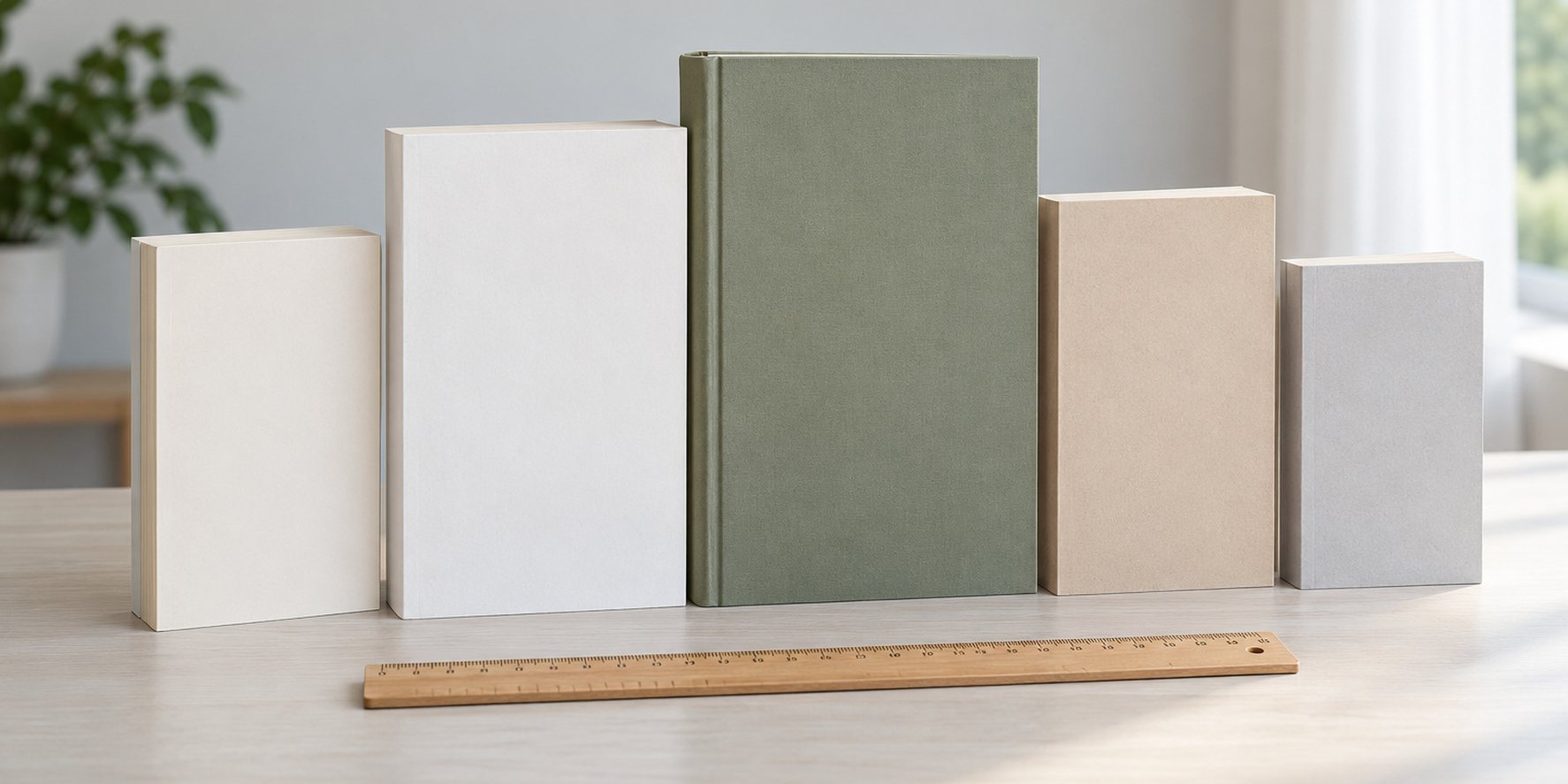
The most common book sizes for self-published paperbacks are 5 x 8, 5.5 x 8.5 and 6 x 9 inches for novels, 6 x 9 inches for most non-fiction, and larger formats such as 8.5 x 8.5 or 8 x 10 inches for children’s picture books. Amazon KDP describes 6 x 9 inches as the most common US paperback trim. The size you choose changes your page count, your printing cost and, on KDP, whether you pay the regular or the large-trim printing rate.
This guide includes a few product links near the end. As an Amazon Associate, Freyja Publishing earns from qualifying purchases, at no extra cost to you.
This guide lists the standard trim sizes on KDP and IngramSpark, recommends sizes by genre, shows with worked numbers how trim size changes cost and royalty, and explains the hardcover and Expanded Distribution limits you need to know before you commit.
At a glance
- Trim size is the finished page size after cutting; it is the “book size” readers see and printers charge for.
- KDP treats anything wider than 6.12 inches or taller than 9 inches as large trim, which costs more per page.
- 6 x 9 inches is regular trim on KDP; 6.14 x 9.21 inches, almost the same size, is large trim.
- KDP hardcovers come in five sizes, need 75-550 pages and cannot use Expanded Distribution.
- IngramSpark offers sizes from 4 x 6 to 8.5 x 11 inches, but not every size works with every binding or paper.
What “book size” actually means
When people ask about the dimensions of a book, they usually mean the trim size: the width and height of a page after the printed sheet is cut. Trim size is always given width first, so a 6 x 9 inch book is 6 inches wide and 9 inches tall (about 15.2 x 22.9 cm).
Three other measurements matter when you publish:
- Spine width, which depends on page count and paper, and sets your full cover size. Our KDP cover calculator guide explains how to work it out.
- Bleed, the extra area printed beyond the trim for images or colour that run to the edge. On KDP interiors, bleed is 0.125 inch (3.2 mm) on the top, bottom and outside edges.
- Margins, the safe area that keeps text away from the cut and the spine.
Standard trim sizes on KDP and IngramSpark
KDP’s trim size help page lists these paperback sizes for Amazon.com. Regular trim: 5 x 8, 5.06 x 7.81, 5.25 x 8, 5.5 x 8.5 and 6 x 9 inches. Large trim: 6.14 x 9.21, 6.69 x 9.61, 7 x 10, 7.44 x 9.69, 7.5 x 9.25, 8 x 10, 8.25 x 6, 8.25 x 8.25, 8.5 x 8.5, 8.5 x 11, 8.25 x 11 and 8.27 x 11.69 inches. KDP also allows custom paperback sizes from 4 to 8.5 inches wide and 6 to 11.69 inches tall.
| Trim size (inches) | Approx. cm | KDP paperback | KDP hardcover | Typical use |
|---|---|---|---|---|
| 5 x 8 | 12.7 x 20.3 | Yes, regular | No | Novels, novellas |
| 5.06 x 7.81 | 12.9 x 19.8 | Yes, regular | No | Novels (close to a UK B-format feel) |
| 5.25 x 8 | 13.3 x 20.3 | Yes, regular | No | Novels |
| 5.5 x 8.5 | 14.0 x 21.6 | Yes, regular | Yes | Novels, memoir, shorter non-fiction |
| 6 x 9 | 15.2 x 22.9 | Yes, regular | Yes | Non-fiction, longer fiction |
| 6.14 x 9.21 | 15.6 x 23.4 | Yes, large | Yes (large) | Non-fiction, hardcover editions |
| 7 x 10 | 17.8 x 25.4 | Yes, large | Yes (large) | Textbooks, illustrated non-fiction |
| 8 x 10 | 20.3 x 25.4 | Yes, large | No | Picture books, photo books |
| 8.5 x 8.5 | 21.6 x 21.6 | Yes, large | No | Square picture books |
| 8.25 x 11 | 21.0 x 27.9 | Yes, large | Yes (large) | Workbooks, large-format hardcovers |
| 8.5 x 11 | 21.6 x 27.9 | Yes, large | No | Workbooks, journals, activity books |
IngramSpark’s help centre says its trim sizes run from 4 x 6 inches up to 8.5 x 11 inches (and 11 x 8.5 landscape), across trade, square, landscape and graphic novel formats, with the full list in its trim size matrix and file creation guide. All sizes are available as perfect-bound paperbacks, while case laminate, cloth and jacketed hardcovers are offered only on certain sizes. IngramSpark also accepts custom paperback sizes within set ranges (for white paper, 4 to 8.5 inches wide and 6 to 11 inches tall), but not landscape custom sizes. For a full comparison of the two services, see KDP or IngramSpark.
Which book size suits your genre?
The best size is usually the one readers already associate with your genre, because a book that looks right on the shelf or in a thumbnail feels right in the hand. Check the listed dimensions of 10 recent bestsellers in your category on the retailer’s product page before deciding.
| Book type | Common trim sizes | Why |
|---|---|---|
| Romance and genre fiction | 5 x 8, 5.25 x 8, 5.5 x 8.5 | Compact, light, familiar trade paperback feel |
| Literary and book-club fiction | 5.5 x 8.5, 6 x 9 | A slightly more substantial look |
| Fantasy and long novels | 6 x 9 | Keeps very long books to a manageable page count |
| Non-fiction and self-help | 5.5 x 8.5, 6 x 9 | Room for headings, lists and tables |
| Memoir | 5.5 x 8.5, 6 x 9 | Matches trade non-fiction |
| Textbooks and illustrated guides | 7 x 10, 8.5 x 11 | Space for diagrams and images |
| Picture books | 8.5 x 8.5, 8.25 x 8.25, 8 x 10 | Large spreads for illustrations |
| Workbooks and journals | 8.5 x 11, 8.25 x 11 | Writing space |
Children’s books bring their own rules on colour, bleed and page count. Our guide to self-publishing a children’s book covers those in detail.
How trim size changes page count, cost and royalty
A smaller page holds fewer words, so the same text makes more pages. On print on demand, more pages means a higher printing cost on every copy. But on KDP, trim size can also move you into a more expensive pricing band.
KDP’s printing cost page gives the Amazon.com formula as a fixed cost plus a per-page cost. At the time of writing (October 2026), black-ink paperbacks of 110-828 pages cost US$1.00 plus US$0.012 per page on regular trim, and US$1.00 plus US$0.017 per page on large trim. Black-ink books of 24-110 pages cost a flat US$2.30 (regular) or US$2.84 (large). Prices change, and other marketplaces have their own figures.
Worked example: one 85,000-word novel, three sizes
| Trim size | KDP band | Estimated pages | Printing cost (US) | Royalty at US$14.99 (60%) |
|---|---|---|---|---|
| 5 x 8 | Regular | About 340 | US$5.08 | US$3.91 |
| 6 x 9 | Regular | About 260 | US$4.12 | US$4.87 |
| 6.14 x 9.21 | Large | About 255 | US$5.34 | US$3.65 |
Page estimates assume around 250 words per page at 5 x 8 inches and around 330 at the larger sizes, plus front and back matter; your real layout will differ. Costs use KDP’s published Amazon.com formula at the time of writing (October 2026), and prices change. KDP pays 60% on Amazon.com paperbacks listed at US$9.99 or more and 50% below that, minus printing cost. The figures show the effect of trim choice, not what any book will earn.
The lesson is the gap between 6 x 9 and 6.14 x 9.21. They look almost identical on a shelf, yet the larger one crosses KDP’s large-trim line and costs more per page. If you want a 6 x 9 feel, 6 x 9 itself is usually the economical choice on KDP. The same principle helps with very long books: moving from 5 x 8 to 5.5 x 8.5 or 6 x 9 can remove many pages while staying in regular trim. Our guide to print-on-demand economics goes further into the numbers, and how to price your book covers setting a list price.
Expanded Distribution and minimum prices
KDP’s Expanded Distribution makes a paperback available to bookshops, libraries and other retailers. According to KDP’s royalty help pages, it pays 40% of list price minus printing cost, so the list price has to cover printing cost divided by 0.40 before you earn anything. Using the 5 x 8 example above, a US$5.08 printing cost needs a list price above about US$12.70. Expanded Distribution eligibility also depends on your trim size, ink and paper combination, and it is not available for hardcovers, so check KDP’s trim size table before you choose a size if wider distribution matters to you.
Hardcover sizes and limits
KDP hardcovers come in five trim sizes: 5.5 x 8.5 and 6 x 9 inches (regular), and 6.14 x 9.21, 7 x 10 and 8.25 x 11 inches (large). They need between 75 and 550 pages, standard colour is not offered, and Expanded Distribution is not available. If you want a hardcover that bookshops and libraries can order through wholesale channels, IngramSpark is the usual route, with case laminate, cloth and jacketed options on selected sizes.
If you plan both formats, choose a paperback size that also exists as a hardcover, such as 5.5 x 8.5 or 6 x 9, so one interior layout can serve both with only margin and cover changes.
Paper, page limits and margins
Page limits vary by size, ink and paper. For a 5 x 8 inch paperback, KDP lists 24-828 pages on black ink with white paper and 24-776 on cream paper; standard colour books need 72-600 pages, and premium colour books 24-828. IngramSpark’s limits are higher on some papers, for example up to 1,050 pages on its 50 lb creme stock.
Margins grow as books get thicker. KDP’s inside (gutter) margin minimums are:
| Page count | Minimum inside margin |
|---|---|
| 24-150 | 0.375 in (9.6 mm) |
| 151-300 | 0.5 in (12.7 mm) |
| 301-500 | 0.625 in (15.9 mm) |
| 501-700 | 0.75 in (19.1 mm) |
| 701-828 | 0.875 in (22.3 mm) |
Outside margins must be at least 0.25 inch without bleed and 0.375 inch with bleed. These are minimums; most professionally set novels use more.
Checklist: choosing your trim size
- Look up the dimensions of 10 recent bestsellers in your exact category.
- Decide whether you need a hardcover, Expanded Distribution or IngramSpark distribution, and rule out sizes that do not support them.
- On KDP, check whether your preferred size is regular or large trim.
- Lay out a sample chapter at two candidate sizes and estimate the total page count.
- Run both page counts through the KDP printing cost calculator and compare royalty at your planned price.
- Choose your paper (cream is common for fiction, white for non-fiction and images) and check its page limits.
- Set margins for your final page count, then build the cover to the exact spine width.
- Order a printed proof before you publish.
Common mistakes
- Picking 6.14 x 9.21 by habit. It is a traditional trade size, but on KDP it costs more per page than 6 x 9.
- Changing trim after the cover is designed. A new size changes page count, spine width and the whole cover file.
- Using a size with no hardcover equivalent when you plan a hardcover later.
- Forgetting the gutter. Thick books need wider inside margins or words disappear into the spine.
- Square picture books on standard colour. Standard colour needs at least 72 pages, so most short picture books use premium colour, which has a different cost.
- Assuming changes are free. On IngramSpark, changing an existing book to a custom size means a new title setup with a new ISBN. Our guide to ISBNs explains why each format needs its own.
Related guide: Hardcover vs Paperback: How to Choose Without Losing Money.
Sources this guide draws on: Amazon KDP help pages on trim size, bleed and margins, print options, printing cost, paperback and hardcover royalties and Expanded Distribution; IngramSpark help centre articles on available trim sizes, bindings and interior papers, and on custom trim sizes.
Writer’s toolkit for this guide
Books and tools we rate for this stage of writing and publishing. As an Amazon Associate, Freyja Publishing earns from qualifying purchases, at no extra cost to you. Prices and availability are set by Amazon and may vary by country.
- Amazon Kindle Paperwhite (16 GB)
Check how your ebook really looks on the device most readers use.
View on Amazon - Nulaxy Adjustable Laptop Stand
Raises your screen to eye level for long writing sessions.
View on Amazon - LEUCHTTURM1917 A5 Hardcover Notebook
Numbered pages and an index, handy for plot notes and research.
View on Amazon
Frequently asked questions
What is the most common book size?
For US paperbacks, KDP describes 6 x 9 inches as the most common trim size. For novels, 5 x 8, 5.25 x 8 and 5.5 x 8.5 inches are also very common. Picture books and workbooks use larger formats.
What size is a standard paperback novel?
Most self-published novels use 5 x 8, 5.25 x 8 or 5.5 x 8.5 inches, with 6 x 9 used for longer books. Smaller mass-market formats exist in traditional publishing, but print-on-demand services focus on trade paperback sizes.
What are the average dimensions of a book in centimetres?
A typical trade paperback novel is around 13-14 cm wide and 20-22 cm tall, for example 5.5 x 8.5 inches is about 14 x 21.6 cm. A 6 x 9 inch non-fiction book is about 15.2 x 22.9 cm.
Which trim size is cheapest to print on KDP?
Any regular trim size (up to 6.12 inches wide and 9 inches tall) uses the lower per-page rate. Within that band, a larger page such as 6 x 9 usually means fewer pages and so a lower cost, provided the size suits your genre.
Can I change my book size after publishing?
You need a new interior and cover file for the new size, and the change affects page count and price. On IngramSpark, changing to a custom size requires a new title setup with a new ISBN. Check the platform’s current rules before you change.
Choose the size your readers expect, check where it sits in each platform’s pricing and distribution rules, and test the numbers before you design the cover. A few minutes with a sample layout and the printing calculator can save money on every copy you sell.