
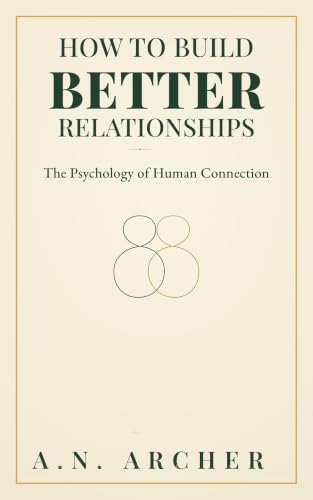
Psychology for Life · Book 1
The Psychology of Human Connection
By A.N. Archer · Published by Freyja Publishing
In How to Build Better Relationships, A.N. Archer draws on more than fifty years of research in psychology, neuroscience and behavioural science to explain how real connection forms, why it so often stalls, and what helps it deepen over time.
This is not a book about becoming more charming, more popular or more socially skilled. It is a clear, evidence-based guide to understanding how people connect — from the first impression to lasting trust, from loneliness to belonging, from conflict to repair.
Choose your edition on Amazon
About How to Build Better Relationships
Most of us learn about relationships by trial and error. We copy what we saw growing up, repeat what seemed to work last time, and are often puzzled when a friendship cools or a conversation turns into an argument. How to Build Better Relationships replaces guesswork with evidence, drawing on more than fifty years of research in psychology, neuroscience and behavioural science.
It is deliberately not a book about charm, popularity or social tricks. Its focus is understanding: how connection forms in the first place, why it so often stalls, and what helps it deepen over months and years. The book moves from first impressions to lasting trust, from loneliness to belonging, and from conflict to repair.
What you’ll explore
Connection is biological as well as emotional. Humans are a social species, and being connected or isolated registers in the body as well as the mind. The book explains why belonging is treated by researchers as a basic need rather than a luxury.
First impressions form fast. People begin forming judgements about warmth and trustworthiness within moments of meeting, often before anything is said. Knowing this helps you understand both how you come across and how quickly you judge others.
Trust, listening and empathy. Trust is built slowly through small, reliable actions and can be damaged quickly. Genuine listening, and empathy that is accurate rather than assumed, are presented as skills that change how people think and feel in a conversation.
Conflict and repair. Disagreement is not the end of a relationship. What matters is how it is handled and whether repair follows. The book looks at how conflict can damage a relationship or, handled well, strengthen it.
Belonging in a digital world. Screens and social media can change how we pay attention to one another and how lonely we feel. The book considers what this means for modern connection.
What lasts. Long-term studies of adult life, such as the Harvard Study of Adult Development that has followed participants since 1938, point to close relationships as one of the strongest predictors of a good life. The book draws out what these studies show about relationships that endure.
Every chapter ends with practical “Where to Begin” steps, and the book closes with a guided 30-Day Relationship Reset to help you put the research into practice.
Who this book is for
Anyone who wants to strengthen the relationships they already have, build new ones with more confidence, communicate more clearly, feel less alone, or simply understand people better.
At a glance
- Series: Psychology for Life, Book 1 of 20
- Author: A.N. Archer
- Publisher: Freyja Publishing
- Length: about 216 pages
- Formats: Kindle eBook, paperback and hardcover
- Kindle edition included with Kindle Unlimited
If you enjoy this book
Each title in the Psychology for Life series stands on its own. Readers of this book often go on to:
- Understanding Emotion (Book 10)
- The Courage To Be Human (Book 11)
- Becoming Yourself (Book 14)