To write a children’s book, first choose the age group you’re writing for, because it sets the word count, length and reading level. Then build a simple story around a child-sized problem that the main character solves for themselves, and write it to be read aloud. Read every draft out loud, cut every word the pictures or the reader don’t need, and only then think about illustration and publishing.
This guide includes a few product links near the end. As an Amazon Associate, Freyja Publishing earns from qualifying purchases, at no extra cost to you.
This guide covers each age band from board books to middle grade, the craft techniques that matter most (especially for picture books), the illustrator question, and what to do once your text is ready.
- Choose the age band first. It decides word count, format and vocabulary.
- Picture books are short and built around page turns. Penguin describes a standard picture book as 32 pages, usually with around 500 to 1,000 words.
- The child character should solve the problem, not a helpful adult.
- Read every draft aloud. Rhythm problems you can’t see on the page are obvious out loud.
- Traditional publishers usually choose the illustrator; self-publishers hire their own.
At a glance
- Choose your age group first, because it sets the word count, format and vocabulary.
- Penguin describes a standard picture book as 32 pages, usually with around 500 to 1,000 words.
- Build the story around a child-sized problem that the child character solves, not a helpful adult.
- Read every draft aloud, cut anything the pictures will show, and only rhyme if it is flawless.
- Traditional publishers usually choose the illustrator, while self-publishers hire their own once the text is final.
- Never pay an upfront-fee “publisher” without researching it, because a traditional publisher pays you.
Step 1: Choose your age group and format
“Children’s book” covers everything from a ten-word board book for babies to a 50,000-word adventure novel for 12-year-olds. Before you write a line, decide who your reader is and which format they read. The table below shows the main bands.
Children’s book types by age
These are guide ranges only. They vary by publisher, series and country, so always check the submission guidelines of the publishers or agents you plan to approach.
| Format | Typical reader age | Typical word range | Typical length | Illustration role | Craft focus |
|---|---|---|---|---|---|
| Board book | Babies and toddlers | Very few words; often a single word or line per page | Short; set by the publisher’s format | Pictures carry almost everything | Simple concepts, repetition, sturdy interactive ideas |
| Picture book | Preschool to the first couple of years of school | Usually around 500 to 1,000 words (Penguin); fewer than 1,000 (Writers & Artists) | Standard 32 pages; occasionally 24 | Equal partner with the text | Page turns, read-aloud rhythm, leaving room for the art |
| Early reader | Children starting to read alone | Set by each levelled series | Short, with simple chapters or sections | Pictures on most pages to support reading | Controlled vocabulary, short sentences, clear action |
| Chapter book | About 5 to 8 | Around 20,000 words is typical (Writers & Artists) | Short chapters | Occasional illustrations | Fast plots, humour, a series-friendly main character |
| Middle grade | About 9 to 12 | 30,000 to 55,000 (Writers & Artists) | Full novel | Usually none inside, apart from the cover | Subplots, real stakes, friendship and identity |
Picture-book figures come from Penguin’s children’s publishing FAQ (New Zealand) and the UK guide Writers & Artists, which says picture books can have as few as 100 words. Above the picture-book stage, the main sign of a good fit is whether a child of that age could read it, or would want it read to them, without losing interest.
Step 2: Find a child-sized idea
Children’s stories work best when the problem is one a child recognises: a lost toy, a new sibling, a first day, a fear of the dark, a friendship gone wrong. The stakes feel enormous to the character even if an adult would shrug.
- Story first, message second. Children (and the adults who buy books for them) can spot a lecture. If your book has a lesson, let it come out of what the character does, not a closing speech.
- Test the idea in one sentence. A small hedgehog who is afraid of the dark has to find her way home after the lantern festival. If the sentence has a character, a want and an obstacle, you have a story.
- Keep it kind. Gentle conflict and real feelings are fine; cruelty, even played for laughs, is not.
Step 3: Build your main character
A few principles hold across most age bands:
- Agency: the main character makes the choices that solve the problem. Adults can help or get in the way, but they shouldn’t fix it.
- Age: children often like to read about characters a little older than themselves. In picture books, animal or object characters avoid the question altogether.
- Voice: one clear trait or habit (bossy, curious, a collector of buttons) makes a character easy to picture and fun to read aloud.
Step 4: Plan the story structure
Picture books: the 32-page layout and page turns
In a standard 32-page picture book, some pages go to the title page, copyright page and dedication, so the story itself usually has fewer pages than that. Exactly how many depends on the publisher’s layout. Think of the story as a series of spreads (two facing pages), and plan each page turn as a small moment of suspense: the reader turns the page to find out what happens.
A simple way to plan is a thumbnail list:
| Spread | Text (one line summary) | What the picture shows | Why turn the page? |
|---|---|---|---|
| 1 | Hedgehog loves the lantern festival | Lights, crowds, her family | Her lantern starts to flicker |
| 2 | Her lantern goes out; she’s alone | Dark woods, a tiny hedgehog | A noise in the bushes |
| 3 | It’s only a moth, also lost | Two small faces, surprised | They decide to look together |
| 4 | …and so on, to the ending | Each picture moves the story on | Every spread ends with a reason to turn |
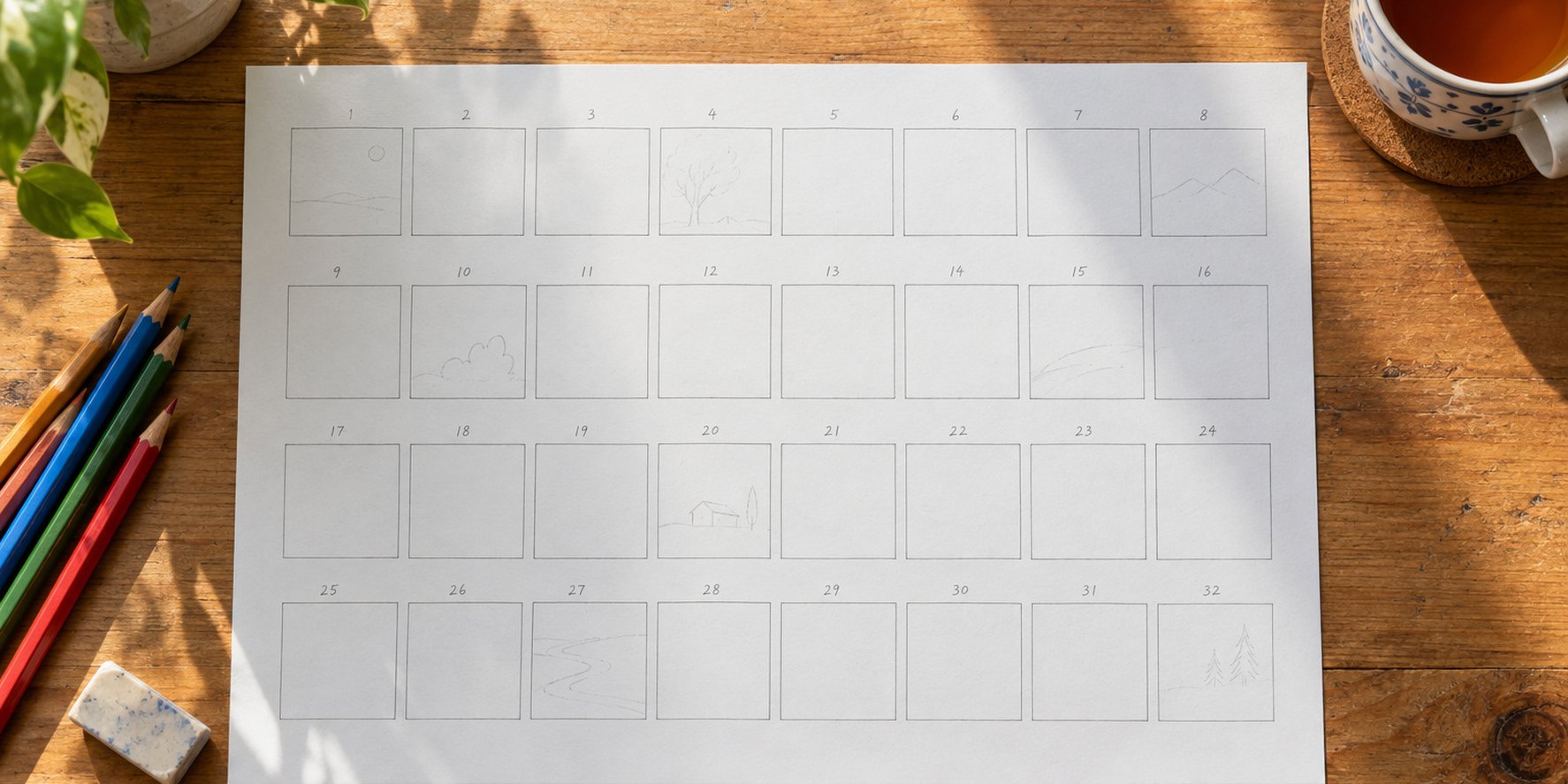
Printing the text on scraps of paper and laying them out across 32 numbered boxes, or making a folded paper mock-up (a “dummy”), shows you at once whether the pacing works.
Early readers and chapter books
Keep chapters short, with a small hook at the end of each. Early-reader series often set vocabulary lists and sentence-length limits, so read the series you are aiming at before you write. Repetition, simple dialogue and visible action help newly independent readers keep going.
Middle grade
Middle grade has room for subplots, a wider cast and real stakes, but the emotional centre is usually one young character. Most middle-grade novels use first person or close third person with one main viewpoint. The story should feel true to that age: friendships, family, fairness and finding where you belong.
Step 5: Write for reading aloud
Picture books are read aloud far more often than they are read silently, often by a tired adult, many times. Write for the voice.
- Rhythm: vary sentence length and end pages on a strong word.
- Repetition and refrains: a repeated line lets children join in. “Not yet,” said Hedgehog. “Not yet, not yet.”
- Sound: words children enjoy saying, such as squelch, wobble or kerplunk, add fun without adding length.
- Rhyme only if it’s flawless. Forced rhyme (twisting a sentence to reach a rhyming word) is one of the most common problems in children’s manuscripts. If the rhyme and metre aren’t natural every time, write in prose.
Here’s an original before-and-after example:
Before: Hedgehog was feeling very scared and frightened because it was extremely dark in the woods and she could not see where she was going at all.
After: The woods were dark. Very dark. Hedgehog held her breath.
The second version is shorter, reads aloud better and leaves the illustrator room to show the fear.
Step 6: Leave room for the illustrations
In a picture book, the art tells half the story. Cut any description the picture will show (colours, clothes, what the room looks like) and keep the text for what the picture can’t show: thoughts, sounds, dialogue and what happens next.
Art notes, short bracketed instructions to the illustrator, should be used sparingly and only when the text would make no sense without them, for example [Art: the “monster” is clearly the cat under a blanket.] Penguin’s FAQ says your story should not rely on illustrations to work.
Step 7: Revise and test
Read your draft aloud, then read it to children, with a parent’s or teacher’s involvement. Watch where they fidget, where they laugh and where they want to turn the page early. Then cut. Most picture-book drafts get shorter with every revision.
Read-aloud revision checklist
- Every page turn has a reason.
- The child character solves the problem.
- No word is wasted; you’ve cut everything the art can show.
- The rhythm survives being read aloud by someone else.
- Vocabulary fits the age band.
- The ending doesn’t lecture.
- The art can show something the text doesn’t say.
- Names and details are consistent throughout.
- Content is safe and kind, with no harm to animals or children, even comically.
- The title suits the age band and is easy to say.
A children’s editor can help too; the guide to editors who specialise in children’s books explains the types of edit.
Do you need an illustrator? Traditional vs self-publishing
| Question | Traditional publishing | Self-publishing |
|---|---|---|
| Do I need an illustrator before I submit? | Usually no. Penguin’s FAQ, for example, says you don’t need to supply illustrations or an illustrator, and that the publisher will work with you to find one. | Yes, you hire and pay one yourself. |
| Who pays for the art? | The publisher | You |
| Who chooses the style? | Mainly the publisher, usually in discussion with you | You |
| Who holds the rights to the art? | Set by the publisher’s contracts | Set by your contract with the illustrator |
| When to start the art | After the publisher accepts the text | Only when the text is final |
If you’re an author-illustrator, you can submit both, but publishers judge text and art separately. If you plan to self-publish, read how to hire and pay an illustrator, and make sure your contract covers the rights between author and illustrator.
What happens next
Submitting to agents or publishers
Many large children’s publishers only take submissions through literary agents, while some publishers open their doors to unagented manuscripts directly, sometimes only at set times. Each sets its own rules, so check the publisher’s or agent’s current guidelines. Submit your best single manuscript, polished and formatted exactly as asked.
Self-publishing
Self-publishing gives you full control and full responsibility for editing, illustration, layout and printing. The step-by-step guide to self-publishing your children’s book covers formats and platforms, and the guide to budgeting for illustration and printing explains the costs. If you sell an ebook edition through Amazon KDP, the 70% royalty option on Amazon.com covers list prices from US$2.99 to US$12.99 (since 7 July 2026), with conditions such as delivery costs and eligible countries.
A warning about upfront-fee “publishers”
First-time children’s authors are a common target for vanity presses. Writer Beware, the scam-watch project of the Science Fiction and Fantasy Writers Association, lists warning signs that include fees left out of a company’s publicity until after you submit, fees presented as “cost sharing”, required book purchases, profit promises, vague pricing and pressure to sign quickly. A traditional publisher pays you; it doesn’t charge you to publish. If a company asks for money, take time to research it before you sign anything.
Common mistakes
- Writing down to children or moralising. Respect the reader; let the story carry the meaning.
- Text far too long for the format. A 2,500-word “picture book” is usually a chapter book or needs cutting by more than half.
- Forced rhyme. If any line bends to fit the rhyme, switch to prose.
- Adults solving the problem. The child reader wants to see a child (or a small creature) win.
- Describing everything the art will show. It wastes words and leaves the illustrator nothing to add.
- Paying an upfront-fee “publisher” without checking. Research any company that asks you for money.
- Commissioning illustrations before the text is final. Every text change after that costs time and money.
- Not reading the market. Read dozens of recent books in your age band before you write your own.
If you also write for older readers, our guide on how to write a novel covers longer manuscripts.
Sources this guide draws on: Penguin’s frequently asked questions about publishing children’s books (Penguin New Zealand); Writers & Artists’ guidance on book length by age group; Writer Beware (Science Fiction and Fantasy Writers Association) on vanity, subsidy and hybrid publishers; and Amazon Kindle Direct Publishing’s ebook list price requirements. All story examples are original to this guide.
Writer’s toolkit for this guide
Books and tools we rate for this stage of writing and publishing. As an Amazon Associate, Freyja Publishing earns from qualifying purchases, at no extra cost to you. Prices and availability are set by Amazon and may vary by country.
- Writing Picture Books by Ann Whitford Paul (revised edition)
A hands-on guide from story idea to submission.
View on Amazon - LEUCHTTURM1917 A5 Hardcover Notebook
Numbered pages and an index, handy for plot notes and research.
View on Amazon - Amazon Kindle Paperwhite (16 GB)
Check how your ebook really looks on the device most readers use.
View on Amazon
Frequently asked questions
How many words should a children’s picture book have?
Usually under 1,000. Penguin’s children’s FAQ says picture books typically have around 500 to 1,000 words, and Writers & Artists notes they can have as few as 100. Shorter is often better, because the pictures carry much of the story.
How many pages is a children’s book?
It depends on the format. A standard picture book is 32 pages, according to Penguin, with occasional 24-page editions; some of those pages go to the title page and other front matter. Chapter books and middle-grade novels are measured in words rather than pages.
Do I need to find an illustrator before I submit to a publisher?
Usually not. Traditional children’s publishers generally choose and pay the illustrator themselves; Penguin’s FAQ says authors don’t need to supply one. If you’re self-publishing, you do need to hire one, but only once your text is final.
Should a children’s book rhyme?
Only if you can make the rhyme and rhythm flawless on every page. Forced rhyme is a common reason manuscripts don’t work. A well-written prose picture book with strong rhythm and repetition reads aloud just as well.
How do I make a children’s book if I can’t draw?
You don’t need to. If you’re submitting to traditional publishers, send the text alone and let the publisher find an illustrator. If you’re self-publishing, hire a professional illustrator with a written contract that covers payment, deadlines and rights.
How long does it take to write a children’s book?
A picture-book draft may be written in days, but most go through many rounds of revision over weeks or months. Middle-grade novels take longer, much like any novel. The time goes into cutting, reading aloud and testing, not the first draft.
Choose the age band, keep the child in charge of the story, and read it aloud until every word earns its place. When you’re ready to share it, the guide to how children build a love of reading is a good reminder of who you’re writing for.