
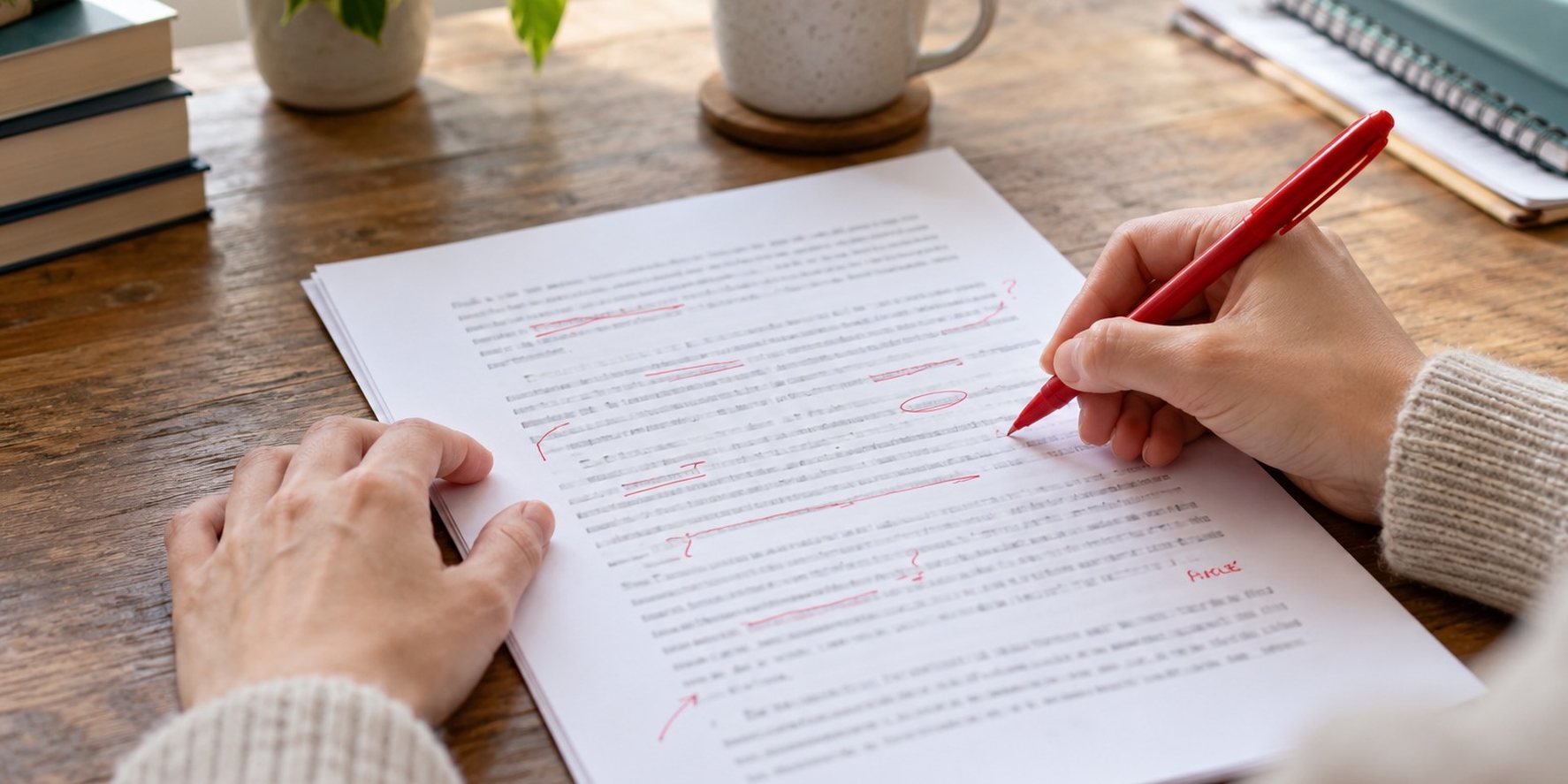
To find the right editor, first decide which kind of edit your manuscript needs, then shortlist three to five editors who work in your genre, ask each for a sample edit of the same passage, and hire the one whose changes make your book clearer while keeping your voice, with a written agreement covering scope, dates and payment. Checking references and a professional association membership helps, but the sample edit tells you the most.
This guide includes a few product links near the end. As an Amazon Associate, Freyja Publishing earns from qualifying purchases, at no extra cost to you.
This guide walks through the types of editing, what they typically cost, where to look, how to vet and compare editors, what a simple contract should say, and how to work together without wasting money. Rates below are in US dollars because the most detailed public survey comes from a US association; rates elsewhere differ, so use them as a guide, not a quote.
At a glance
- Different edits do different jobs: developmental (story and structure), line (sentences and style), copyediting (accuracy and consistency) and proofreading (final errors).
- Do them in that order, and do not pay for a proofread before the big changes are finished.
- A sample edit is the best test. Send the same pages to each shortlisted editor and compare.
- Get it in writing: scope, word count, deadline, deliverables, payment schedule and what happens if either side cancels.
- Budget by word count. On the Editorial Freelancers Association’s 2026 survey, copyediting fiction typically ran about 2 to 2.7 US cents a word.
Step 1: work out which edit you need
Many new authors ask for “an edit” and get the wrong one. The four main types build on each other:
| Edit type | What the editor looks at | When to use it | What you receive |
|---|---|---|---|
| Developmental (structural) edit | Plot, structure, pacing, character arcs, argument (for non-fiction), what to cut or add | After you have revised the draft yourself and before polishing sentences | An editorial letter, often with margin notes |
| Manuscript assessment | A lighter, big-picture read with a report | When you want structural feedback but cannot afford a full developmental edit | A report of several pages |
| Line edit | Clarity, flow, word choice, rhythm and tone, sentence by sentence | Once the structure is settled | Tracked changes and comments |
| Copyedit | Grammar, punctuation, spelling, consistency of names, timelines and style; factual queries | When the content is final | Tracked changes plus a style sheet |
| Proofread | Typos and layout errors in the near-final or formatted text | Last, ideally on the formatted files | Marked corrections |
Line editing and copyediting overlap, and some editors offer them as one service. Always ask exactly what an editor’s “edit” includes. If budget is tight, the usual order of priority is: a careful self-edit and beta readers first, then a copyedit, then a proofread. A developmental edit is most valuable for first novels and books that have stalled. The self-editing guide covers what to fix before you pay anyone, and tools such as those compared in ProWritingAid versus Grammarly can catch surface errors cheaply, though they do not replace a human edit.
Step 2: set a realistic budget
Editors charge per word, per hour or per project. The most detailed public benchmark is the Editorial Freelancers Association (EFA) rate chart, updated in March 2026 from a survey of more than 1,100 members about the rates they charged in 2025. The EFA stresses that it does not set rates and that individual rates vary with experience, turnaround and type of work. Its ranges for fiction were roughly:
| Service (fiction) | Typical range per word (US cents) | An 80,000-word novel would be about |
|---|---|---|
| Line editing | 2.7 to 3.5 | US$2,160 to US$2,800 |
| Copyediting | 2.0 to 2.7 | US$1,600 to US$2,160 |
| Proofreading | 1.2 to 2.0 | US$960 to US$1,600 |
The same chart lists higher ranges for non-fiction, for example 3 to 4 cents a word for copyediting. It does not give a general figure for developmental editing of fiction or non-fiction, which is often quoted per project and varies widely, so get several quotes. These are survey ranges, not prices; at the time of writing (October 2026), rates in other countries and on freelance marketplaces can be noticeably higher or lower, and prices change. For the full picture of what a book costs to produce, see the guide to self-publishing costs.
A quick way to judge value: divide the quote by your profit per copy. If you earn about US$3 a copy and a copyedit costs US$1,800, you need roughly 600 extra sales over the book’s life to cover it. Editing rarely pays back in one book alone; it pays back through better reviews, read-through and a backlist that keeps selling.
Step 3: find candidates
- Professional associations’ directories. Examples include the Editorial Freelancers Association (US), the Chartered Institute of Editing and Proofreading (UK), Editors Canada and the Institute of Professional Editors (Australia and New Zealand). Membership is not a guarantee of quality, but many have training, codes of practice or credentials.
- Curated marketplaces such as Reedsy, which vet editors before listing them, and general freelance marketplaces such as Upwork, where quality varies more and you must vet carefully.
- Acknowledgements pages of indie books in your genre that you admire.
- Recommendations from author communities and genre groups.
Genre experience matters. A romance editor will know reader expectations around pacing and endings; a thriller editor will spot plot holes and timing slips; a non-fiction editor should be comfortable querying facts and structure.
Step 4: vet and compare editors
Send each shortlisted editor the same information: genre, word count, the type of edit you want, your preferred dates and the same sample passage. Then compare their answers side by side.
Questions to ask every editor
- Which genres do you edit most, and which recent books can I look at?
- What exactly is included in this edit, and what is not?
- Do you offer a sample edit, and is it free or paid?
- Which style guide and spelling convention will you follow (for example, US or British/Australian spelling)?
- When can you start, and when will I get the manuscript back?
- How do you deliver the edit (tracked changes, editorial letter, style sheet)?
- Are questions or a follow-up call after the edit included?
- How do you handle disagreements about an edit?
- What are your payment terms and cancellation terms?
- Can I contact one or two recent clients?
What to look for in the sample edit
- Changes that make your sentences clearer without making them sound like someone else.
- Comments that explain why, not just what.
- Queries rather than silent rewrites where meaning is uncertain.
- Catching things you missed, such as repeated words, timeline slips or unclear dialogue tags.
- A tone that is direct and respectful.
Step 5: put the agreement in writing
A one-page agreement, or an email that the editor confirms, avoids most disputes. It should cover:
| Item | What to specify |
|---|---|
| Scope | Type of edit, word count, any extras such as a second pass |
| Dates | When you will send the manuscript and when it will be returned |
| Deliverables | Tracked-changes file, editorial letter, style sheet, call |
| Fee and payment | Total fee or rate, deposit, and when the balance is due |
| Changes in word count | How the fee changes if the manuscript is longer than quoted |
| Cancellation | What is paid or refunded if either side cancels |
| Rights and confidentiality | You keep all rights; the editor will not share the manuscript without permission |
A deposit with the balance on delivery is common, and staged payments are sensible for longer projects. Paying 100% upfront to someone you have never worked with is a risk; if you do, use a payment method that offers some protection.
Step 6: work well together
Before: finish the draft and do your own revision pass. Send a clean file in the agreed format, with a short note on your goals and any style choices (for example, deliberate fragments or dialect). Paying an editor to fix things you already knew about wastes money.
During: stay reachable for questions, and do not keep revising your copy while the editor works on theirs.
After: read the whole edit before reacting. You do not have to accept every change; it is your book. But if you find yourself rejecting most of the suggestions, the match was probably wrong. Thank your editor, credit them in the acknowledgements if they agree, and book the next project early, as good editors fill up months ahead. Build the editing slots into your publishing timeline so a late edit does not push your launch.
Who should hire which editor
- First novel, unsure if the story works: a manuscript assessment or developmental edit, then a copyedit.
- Experienced author, strong beta readers: copyedit plus proofread.
- Non-fiction with facts and references: a copyeditor experienced in your field who queries facts.
- Very tight budget: thorough self-edit, beta readers, then the best copyedit you can afford.
Red flags
- No samples, no client list and no sample edit offered.
- A price far below every other quote, or a promise to edit a full novel in a couple of days.
- Vague scope (“I’ll give it a good edit”).
- Pressure to pay everything upfront, or to buy extra packages.
- Rewrites that flatten your voice into the editor’s style.
- Claims that an edit will guarantee sales, an agent or a bestseller.
- Slow or evasive replies before you have even hired them.
Common mistakes
- Booking a proofread first and then making big changes, so it has to be redone.
- Choosing on price alone instead of on the sample edit.
- Sending different sample pages to different editors, which makes comparison impossible.
- Skipping the style sheet, then losing consistency across a series. Keep it and pass it to the next editor or proofreader.
- No buffer before launch. Editors’ availability and your own revisions both take longer than planned.
- Using an editor as a cover designer or formatter without checking that they are experienced at it. Those are separate skills; see the guide to choosing a cover designer.
If this is your first book, the guide to self-publishing your first book shows where editing fits in the whole process, and the author toolkit guide compares the software and services authors use alongside a human editor.
Related guide: Ghostwriting: How to Hire the Right Writer Without Regret.
Sources this guide draws on: the Editorial Freelancers Association 2026 Rate Chart (updated March 2026); published descriptions of editing services from professional editing associations, including the Chartered Institute of Editing and Proofreading, Editors Canada and the Institute of Professional Editors.
Writer’s toolkit for this guide
Books and tools we rate for this stage of writing and publishing. As an Amazon Associate, Freyja Publishing earns from qualifying purchases, at no extra cost to you. Prices and availability are set by Amazon and may vary by country.
- On Writing: A Memoir of the Craft by Stephen King
Part memoir, part masterclass on the daily habit of writing.
View on Amazon - LEUCHTTURM1917 A5 Hardcover Notebook
Numbered pages and an index, handy for plot notes and research.
View on Amazon - Nulaxy Adjustable Laptop Stand
Raises your screen to eye level for long writing sessions.
View on Amazon
FAQ
How much does it cost to edit an 80,000-word novel?
Using the Editorial Freelancers Association’s 2026 survey ranges for fiction, a copyedit would be roughly US$1,600 to US$2,160 and a proofread roughly US$960 to US$1,600. A developmental edit is usually quoted per project and varies widely. Rates differ by country and by editor, so get several quotes.
What is the difference between copyediting and proofreading?
Copyediting fixes grammar, punctuation, consistency and clarity in the text and queries facts. Proofreading is a final check for remaining errors, ideally on the formatted book. A proofread is not a substitute for a copyedit.
Do I need a developmental editor?
Not always. It is most useful for a first novel, a book that is not working and you cannot see why, or a non-fiction book whose structure is unclear. Experienced authors with strong beta readers often skip it and go straight to a copyedit.
Should a sample edit be free?
Many editors offer a short free sample of a few pages; others charge for a longer one. Either is reasonable. What matters is that every editor you compare edits the same passage.
How long does a professional edit take?
It depends on the type of edit, the word count and the editor’s schedule. A full edit of a novel normally takes weeks rather than days, and popular editors are often booked months ahead, so contact them well before your planned launch.
Can AI tools replace an editor?
Grammar and style tools can catch many surface errors and are useful before you send a manuscript out. They do not judge structure, character, pacing or what your readers expect the way an experienced human editor does, so treat them as a first pass, not a replacement.
Decide what your manuscript needs, compare editors on the same sample, agree the details in writing, and you will spend your editing budget where it actually improves the book.