To produce and distribute an audiobook, you choose a narration route (a professional narrator, yourself, or an approved digital voice), record and master the audio to retailer specifications, and then upload it either to Audible through ACX or to a wide distributor that reaches Spotify, Apple, Google Play, Kobo and libraries. The two decisions that shape your costs and income are who narrates and whether you go exclusive with Audible.
This guide includes a few product links near the end. As an Amazon Associate, Freyja Publishing earns from qualifying purchases, at no extra cost to you.
This guide is the overview: it walks through each production route, what they cost, the technical standards your files must meet, and how the main distribution options compare after the big changes of 2025 and 2026. It is written for self-published authors deciding whether, and how, to add audio to a book that already exists in ebook or print.
At a glance
- Budget by finished hour: a finished hour is roughly 9,300 words, so a 75,000-word novel runs about eight hours.
- ACX changed in 2026: a new royalty model pays 50% exclusive or 30% non-exclusive (up from 40% and 25%), calculated on a new base; legacy terms end on 31 December 2026.
- Findaway Voices is gone: since August 2025, Spotify for Authors handles uploads to Spotify and Voices by INaudio handles wide distribution.
- AI narration is store by store: ACX requires human narration unless Audible authorises otherwise, while several other stores accept labelled digital voices.
- Quality control is your job: listen to every file before approving it.
Is an audiobook worth it for your book?
Audio reaches people who rarely read in print or on screen: commuters, people who listen while exercising or doing chores, and readers with visual or reading difficulties. Many listeners also stick with an author’s series once they like a narrator, which is why audio tends to pay off best for fiction series and practical non-fiction with a clear audience.
It is a weaker bet for a standalone book with very few sales, books that depend on charts, tables or images, and workbooks. In those cases, improve the ebook’s sales first; an audiobook amplifies demand, it doesn’t create it. If you are weighing audio against other income ideas, see alternative revenue streams for self-published authors.
Step 1: choose your narration route
| Route | Upfront cost | Quality ceiling | Where you can sell it | Suits |
|---|---|---|---|---|
| Professional narrator, paid per finished hour | Highest; you own the audio outright | Highest | Everywhere | Fiction series, books with dialogue and character voices |
| Narrator on royalty share (ACX) | None | High, depends on who accepts | Audible exclusive while the deal lasts | Authors with sales history who can’t fund upfront costs |
| Self-narration | Equipment and your time | Varies widely | Everywhere | Memoir, personal non-fiction, experienced speakers |
| Store-provided digital voice (for example KDP Virtual Voice, Google Play Books auto-narration, Apple Books digital narration) | Low or none | Good for clear non-fiction; weaker for emotional fiction | Usually only that store or partners | Backlist titles, practical guides, testing demand |
| Third-party AI voice files | Low | Varies | Only stores that accept them | Wide distribution where permitted, after checking each store’s rules |
Professional narrators
Narrators usually quote a rate per finished hour (PFH), meaning per hour of final audio, not per hour of studio time. Author’s Republic’s guidance puts typical rates anywhere from about US$100 PFH for newer narrators to US$300–US$1,000 or more for experts, at the time of writing (October 2026); prices change and vary by country and union status. Rates normally include preparation, recording, pickups, editing and mastering, but confirm in writing.
To estimate your budget, divide your narrated word count by 9,300 and multiply by the PFH rate. A 75,000-word novel is about eight finished hours, so a narrator at US$250 PFH would cost about US$2,000.
Royalty share
On ACX, a narrator can produce your book for a share of royalties instead of a fee. Under ACX’s new model, rights holder and producer each receive 25%; under the legacy model it was 20% each. Royalty share ties the title to Audible exclusivity for the term of the deal, so it trades upfront cost for flexibility.
Self-narration
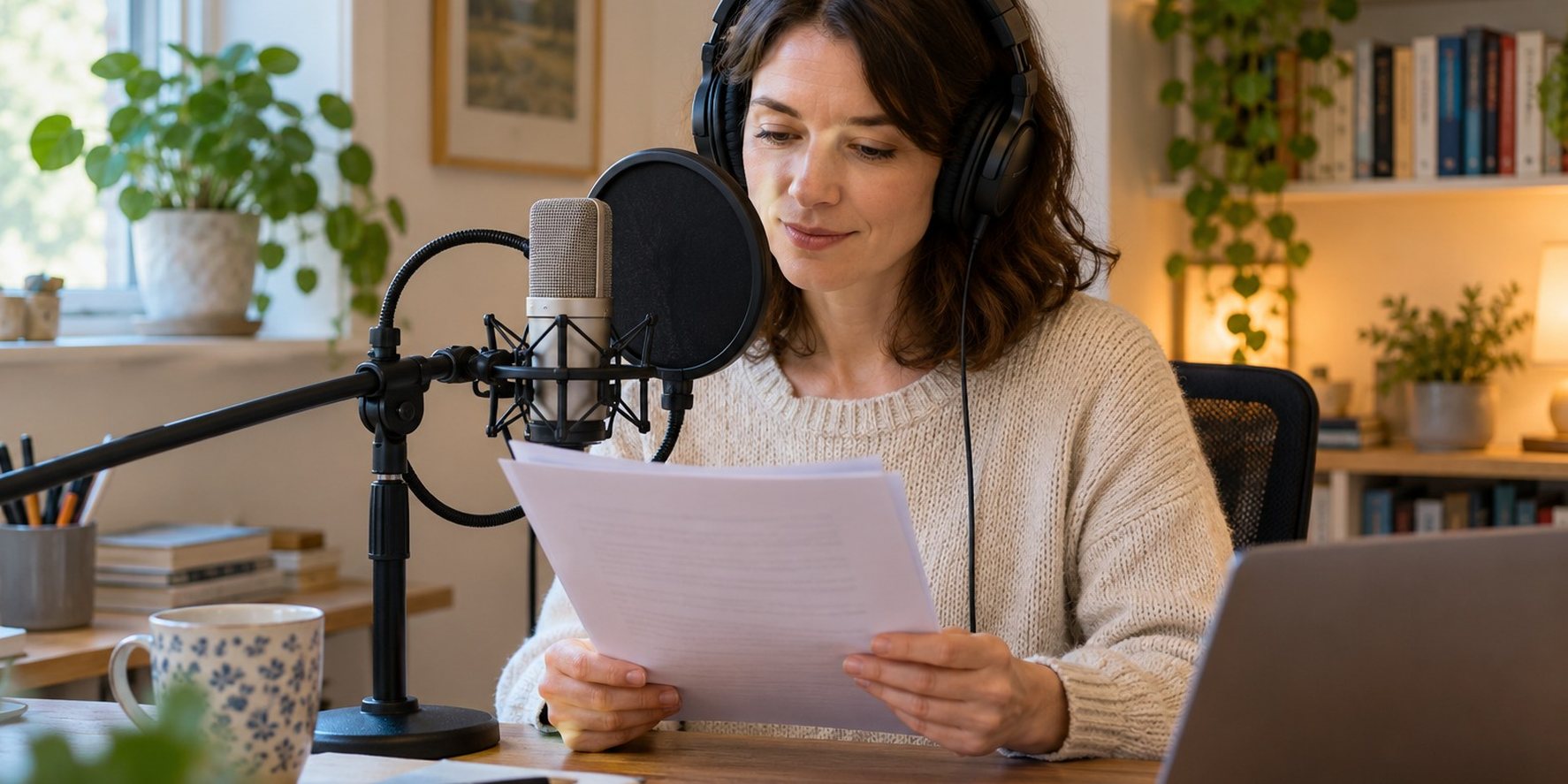
Narrating yourself saves money but demands time: recording, re-recording mistakes, editing out breaths and noise, then mastering every chapter. A quiet, treated space matters more than an expensive microphone. If you go this way, record one chapter, master it and test it against the specifications in Step 3 before committing to the whole book.
Digital and AI narration
This is where the rules have moved fastest. KDP’s Virtual Voice is an invite-only beta for eligible Kindle ebooks in the US marketplace, paying a 40% royalty during the beta on list prices from US$3.99 to US$14.99; if the ebook is in KDP Select, the Virtual Voice audiobook stays exclusive to Audible for that enrolment period. ACX itself requires human narration unless Audible has authorised otherwise. Google Play Books and Apple Books offer their own digital narration, and Kobo accepts labelled synthetic narration. Policies change often, so read each store’s current rules before you produce anything. For the bigger picture on AI in publishing, see how AI is changing self-publishing.
Step 2: run the production workflow
- Prepare the script. Use the final, proofread manuscript. Remove or rewrite anything that only works visually, such as tables, links and “see the diagram below”.
- Write a pronunciation and character guide. List names, places, invented words and technical terms with how to say them, plus a line on each main character’s age, accent and personality.
- Audition narrators. Post a short audition script with dialogue and narration and ask for a few minutes of recorded sample. Listen on headphones and on a phone speaker.
- Agree terms in writing. Rate or royalty share, delivery dates, number of correction rounds, who owns the files and who uploads them.
- Approve the first 15 minutes. Most problems (pace, tone, a mispronounced name) can be fixed cheaply at this stage.
- Proof-listen every chapter. Follow along in the text and note timestamps for errors, then send one consolidated list of pickups.
- Prepare the audio cover. Audiobook covers are square; adapt your ebook cover rather than cropping it.
- Write audio-specific metadata. Add the narrator’s name, the running time and a description that mentions the narrator if they are well known.
Step 3: meet the technical standards
ACX publishes the most widely used specification, and files that meet it are generally accepted elsewhere too. Check each distributor’s own page, but expect these requirements:
- Each file is one chapter or section, with its spoken header (for example “Chapter One”); opening and closing credits go in separate files.
- Average loudness (RMS) between −23 dB and −18 dB; peaks no higher than −3 dB; noise floor below −60 dB.
- MP3 at 192 kbps or higher, constant bit rate, 44.1 kHz; all files consistently mono or all stereo.
- About 1 to 5 seconds of room tone at the start and end of each file, with no silent gaps longer than 5 seconds.
- No file longer than 120 minutes.
- A retail sample of five minutes or less, ideally from the opening, with no explicit material.
Step 4: choose how to distribute
The landscape changed twice recently. In 2025, Spotify ended Findaway Voices: uploads to Spotify now go through Spotify for Authors, and wide distribution passed to a new company, Voices by INaudio. In 2026, ACX introduced a new royalty model for Audible.
| Option | Reach | Royalty basis | Exclusivity | Watch out for |
|---|---|---|---|---|
| ACX, exclusive (new model) | Audible and Amazon | 50% of list price on cash sales; member listening paid from a “Member Value” pool | Exclusive to Audible; minimum term now 90 days | Member Value calculation is not published in detail |
| ACX, non-exclusive (new model) | Audible and Amazon | 30% | None; you can also distribute elsewhere | Lower rate on Audible sales |
| Spotify for Authors | Spotify | Set by Spotify’s terms | Non-exclusive | Digital-voice titles accepted for Spotify only |
| Voices by INaudio | Many retailers and library platforms worldwide | Share of what each retailer pays | Non-exclusive | Accepts only approved digital-voice packages |
| Direct to retailers (for example Google Play Books, Kobo) | That store | Store’s own rate | Non-exclusive | More dashboards to manage |
| Sell direct from your website | Your own readers | Price minus platform fees | None | You handle delivery and customer support |
What the ACX change means
Titles not enrolled in the new model keep legacy rates (40% exclusive, 25% non-exclusive) until 31 December 2026. From 1 January 2027 the legacy model ends and ACX will begin withdrawing unenrolled titles, which can be reinstated by accepting the new terms. The higher percentages apply to a new base: for Audible members, your royalty is your share of a pool built from members’ plan prices and extra credits, weighted by list price. The Alliance of Independent Authors has noted that this is harder for authors to forecast. If you are on ACX already, enrol or plan your exit before the deadline.
Exclusive or wide?
Exclusivity can make sense if most of your readers are on Amazon and you want simplicity. Going wide makes sense if you want libraries, Spotify listeners and stores outside Amazon, or if you dislike depending on one retailer. The new 90-day minimum exclusivity term makes it easier to try exclusive first and change later. Our distribution channels guide covers the wide-versus-exclusive question for ebooks and print too.
After release: making the audiobook earn
- Tell your list. Your newsletter is the fastest way to reach existing fans who prefer audio; see how authors build profitable email lists.
- Use the narrator’s audience. Popular narrators have their own followers; share assets they can post.
- Produce series in order. Listeners who finish book one look for book two in audio; gaps lose them. Our series planning guide explains why series compound.
- Repurpose with care. Short excerpts work well as social clips or podcast samples, but check your distribution contract first.
- Track by channel. Note sales and listening by store so you know where to focus the next production budget.
Common mistakes
- Choosing a narrator from one polished demo. Always ask for a custom audition from your own manuscript.
- Not budgeting for proof-listening. Someone must listen to every minute; errors in reviews are expensive.
- Uploading AI audio to a store that bans it. Titles can be removed and accounts flagged.
- Signing royalty share without reading the term. It ties the title to Audible exclusivity for the length of the agreement.
- Ignoring the ACX 2026 deadline. Unenrolled titles face withdrawal from January 2027.
- Leaving visual content in the script. “As the table shows” means nothing to a listener.
- Forgetting the square cover and narrator credit in metadata.
Sources this guide draws on: ACX Help Center articles on royalties and audio submission requirements, Amazon KDP Help on Virtual Voice, Spotify for Authors guidance for self-published authors, Alliance of Independent Authors reporting on the end of Findaway Voices and the 2026 Audible royalty model, Author’s Republic guidance on per-finished-hour rates.
Writer’s toolkit for this guide
Books and tools we rate for this stage of writing and publishing. As an Amazon Associate, Freyja Publishing earns from qualifying purchases, at no extra cost to you. Prices and availability are set by Amazon and may vary by country.
- Amazon Kindle Paperwhite (16 GB)
Check how your ebook really looks on the device most readers use.
View on Amazon - Nulaxy Adjustable Laptop Stand
Raises your screen to eye level for long writing sessions.
View on Amazon - LEUCHTTURM1917 A5 Hardcover Notebook
Numbered pages and an index, handy for plot notes and research.
View on Amazon
FAQ
How much does it cost to produce an audiobook?
It ranges from almost nothing (self-narration or a store’s digital voice) to several thousand dollars for an experienced narrator. Estimate finished hours by dividing your word count by about 9,300, then multiply by the narrator’s per-finished-hour rate.
What royalty does ACX pay in 2026?
Under the new model introduced on 26 May 2026, ACX pays 50% for exclusive and 30% for non-exclusive distribution, on a new calculation base for member listening. The legacy 40% and 25% rates end on 31 December 2026.
Can I put an AI-narrated audiobook on Audible?
Not through ACX unless Audible has authorised it; ACX requires human narration. Amazon’s own route is KDP Virtual Voice, an invite-only US beta for eligible Kindle ebooks.
What replaced Findaway Voices?
Findaway Voices by Spotify closed on 1 August 2025. Spotify for Authors handles uploads to Spotify, and Voices by INaudio took over wide distribution to other retailers and library platforms.
How long does audiobook production take?
With a professional narrator, plan for several weeks to a few months from audition to retail, depending on length and the narrator’s schedule. Self-narration usually takes longer because editing and mastering are time-consuming.
An audiobook turns a finished book into a new format for a different audience, but the money is made or lost in the early decisions: narration route, exclusivity and quality control. Get those right, meet the file specifications and keep your series consistent in audio. For narration, editing and audio tools alongside the rest of your software, see our author toolkit.